Baking Paper for Commercial Ovens: Temperature Resistance, Coating Uniformity, and Food Safety
Commercial bakeries, frozen food factories and central kitchens rely heavily on baking paper for mass production. Unlike household parchment paper, baking paper used in industrial ovens must withstand prolonged high heat, repeated contact with grease and oil, and meet strict global food-contact regulations.
When sourcing parchment paper for commercial ovens, three core performance metrics decide production stability: temperature resistance, coating uniformity, and food safety compliance. Poor-quality baking paper causes sticking, oil penetration, paper burning, product contamination and costly production downtime. This guide helps bulk buyers evaluate suppliers and select the right parchment paper for commercial oven lines.
1. Temperature Resistance for Commercial Ovens
Commercial ovens include rotary rack ovens, deck ovens, tunnel ovens and convection production lines. Temperatures vary widely from 160°C up to 230°C, sometimes with long continuous baking cycles.
Standard performance specification
Food-grade double-sided silicone coated parchment paper can withstand continuous working temperature up to 230°C (446°F) for 30–60 minutes, suitable for bread, pastries, cookies, frozen bakery products.
Peak short-time tolerance can reach 250°C, but we do not recommend continuous use above 230°C.

Sourcing notes for different oven types
Tunnel ovens: Long dwell time inside the oven. Choose 42–45gsm heavy-duty parchment. Thin paper (below 40gsm) risks brittleness and tearing under prolonged heating.
Rotary & deck ovens: Frequent loading/unloading, temperature fluctuation. Stable silicone coating prevents cracking when paper expands and contracts.
High-fat products (croissants, buttery pastries): Higher heat plus heavy grease will accelerate coating failure. Upgrade to heavier grammage paper.
⚠️ Common problem: Low-cost paper may state "230°C resistance" on datasheets, but fails in real long commercial baking cycles. Always request factory baking test reports and pre-production samples for trial runs in your actual oven.
2. Coating Uniformity: The Hidden Factor Affecting Your Production
Silicone coating uniformity is the most overlooked technical indicator for industrial baking paper. The silicone layer provides non-stick and grease-proof performance.
What happens with uneven coating?
Thin coating areas: Oil soaks through the paper, pastry sticks to the sheet, product rejects increase.
Over-coated spots: Excess silicone may transfer onto baked goods, creating surface defects.
Partial missing coating: Bare paper areas burn easily in high-temperature ovens.
Our factory coating control standard
We apply double-sided food-grade silicone via continuous coating lines, with controlled coating weight: 0.8–1.2 g/m² per side.
Online visual inspection during production
Sampling test for oil penetration and peel strength every production batch
Consistent coating across the full paper width, critical for wide rolls used on automated production lines
Tip for buyers: When testing samples, place the paper under high-fat baking conditions and check for uneven oil penetration after baking. This quickly reveals poor coating uniformity.
3. Food Safety & Global Compliance
For commercial food manufacturers, food safety is non-negotiable, especially for products exported to EU and North America.
Mandatory standards
USA market: FDA 21 CFR 176.170 for food contact materials
EU market: Regulation (EC) No 1935/2004 + German LFGB certification
PPWR 2026 requirement: PFAS-free formulation. PFAS (forever chemicals) are restricted under EU PPWR. All silicone coating and raw pulp must be free from PFAS.
Additional declarations
BPA-free
Chlorine-free (unbleached brown parchment)
MSDS material safety datasheet
Batch traceability records for audits and market surveillance
⚠️ Risk reminder: Many cheap suppliers only provide self-declaration instead of third-party lab PFAS test reports. For EU shipments, third-party test certificates are required for customs and authority inspection, avoiding detention or product recall.

4. How to Select the Right Parchment Paper for Your Oven Line
Confirm your maximum continuous oven temperature and baking duration.
Choose grammage:
38–40gsm: Standard for cookies, low-fat baked goods
42–45gsm: Heavy-duty for tunnel ovens, croissants, high oil content pastries
Pick single-sided or double-sided silicone coating:
Double-sided silicone coating: recommended for commercial production, better grease resistance, reversible use
Single-sided: cost-saving option for simple low-fat baking
Test samples on your actual production line before bulk order. Lab data does not always match real oven working conditions.
5. Our Factory Support for Commercial Oven Baking Paper
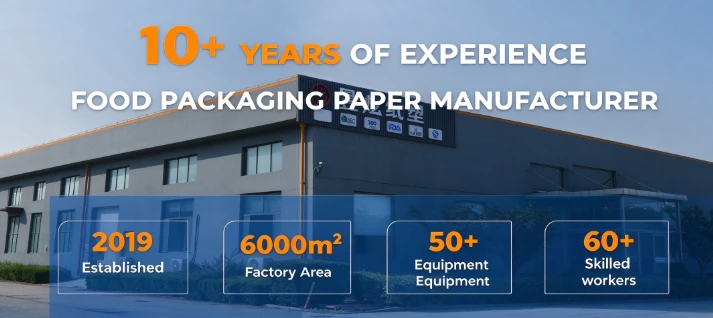
As a professional silicone parchment paper manufacturer in Shandong, we supply baking paper rolls and pre-cut sheets for large commercial bakeries and frozen food factories. ✅ PFAS-free double-sided silicone coating ✅ Stable temperature resistance up to 230°C ✅ Strict online coating inspection to guarantee uniformity ✅ Complete certification package: FDA, LFGB, PFAS-free test report, MSDS ✅ Custom roll width, custom pre-cut sheet sizes, OEM printed paper available ✅ Goods shipped from Qingdao port, support FCL and LCL consolidated shipments.
FAQ
Q: Can silicone baking paper be reused in commercial ovens?
A: It depends on baking conditions. For low-temperature, low-fat products, it can be reused a few times. For high-fat and high-temperature baking, single use is recommended to avoid silicone degradation and contamination risk.
Q: What causes parchment paper to turn brittle after baking?
A: Three main reasons: insufficient paper grammage, poor silicone coating quality, or continuous baking above the rated temperature.
Q: Is unbleached baking paper better than bleached white paper for commercial production?
A: Functionally similar in heat resistance. Unbleached paper is chlorine-free and preferred for EU eco-focused brands; white bleached paper offers cleaner visual appearance for retail finished pastries.
Share your oven type, maximum baking temperature and product type with us. Request free samples and full compliance documents for your commercial bakery project.